
The original Vespas
Hornets and their paper palaces

Let me start with a trivia.
What is the link between the two photos?


If you know the answer, you can drop a comment below, before reading the rest of the blog.
Now, the answer.
The first photo is the famous Italian scooter Vespa. The second one is the nest of hornets that I found inside the IIM Bangalore campus.
The story goes like this. At the end of the world war II, Italy was looking to rebuild its economy. Enrico Piaggio, a prominent industrialist commissioned Corradino D’Ascanio to build a two-wheeler for the common Italian.
D’Ascanio built a sleek aerodynamic two-wheeler fitted with a 98cc engine. When Piaggio saw the vehicle with its many curves and heard its sound, he exclaimed “it sounds like a vespa!” (Vespa in Italian means wasp) giving the famous scooter its name.
And what we see on the right is one of the largest wasps - the hornets buzzing around their nest.
It is unfortunate that most of us know more about the scooter more than the being it was named after. Hornets are many a times confused with honeybees but they are very different. They belong to the family of wasps.
Hornets also have a very bad reputation for being aggressive. There is a partial truth to it. They are usually harmless if left alone. If they feel threatened, because we go closer to their nest, attack the nest or kill one hornet, they can get angry and charge. Well, anyone would. What makes them dangerous and scary to most people is that they do not charge alone. They charge together.
Once I got into a road rage fight. I was with a very close friend of mine and the driver of the other vehicle was shouting at me bordering getting abusive. I wasn’t backing down either.
My friend called him brother who stayed nearby. He came down rushing into the fight with no knowledge of what was happening. He heard that there was a fight and he was there. I was grateful to both of them for it that day.
The hornets are like that. If any hornet feels threatened, they release a specific pheromone. That gets everyone else riled up too and they are out into the fight together.
Hornets which get killed by accident also release the pheromone. So if you happen to be nearby, you become a likely target. That is one reason to be weary of them, for sure.
What makes them extra deadly is that unlike honeybees who die after stinging, hornets can sting multiple times, they are more painful and some hornets are among the most venomous insects.
This has definitely given them a bad reputation. But that is not all there is to hornets.
They are excellent in pest control and excellent architects.
The hornets love sugary plant food - having anything from sugary plant sap to having fruit nectar but they are also excellent predators. They prey on flies, bees and other insects, moderating their population. The funny thing is that they do not eat the insects themselves but feed them to their larvae.
Some species actively chase and hunt bees and there is a plant that has found a way to trick them for it. An orchid Dendrobium christyanum endemic to an island in China has found an excellent adaptation.
It releases a special pheromone that matches that of a distressed bee. Keen to find a distressed bee, the hornet follows the trail to the flower, thereby pollinating them.
Nature never fails to surprise you!
Hornets, therefore, do an excellent service in the ecosystem.
Another fascinating aspect is their nest.
When I first saw a hornet’s nest, I was mesmerized.
What a delight it was to spot them! The nest had this beautiful design like someone did swirls on freshly poured cake batter. It was the color of the sand and it was almost 1.5 times the size of a basketball. The nest was built around 2 of the branches hanging comfortably.
It is interesting to know how the hornet nest is made. The hornet nest is started by the queen hornet who chews the bark of the tree and then produces a paper-like structure to build the cells very similar to that of the honey bee cells. The queen creates about 50 cells to start her colony. She chooses a dark spot to ensure that her nest is safe. In the 50 cells she lays her eggs. She then feeds the larvae and raises them to become the future workers of the colony - all of them female.
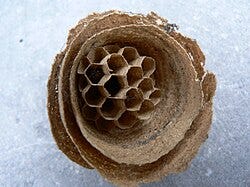
Once the workers come out, they further build the rest of the colony where the queen lays the rest of the eggs. These workers then take on the job of building the colony and feeding the colony with sugary substances required for the queen to raise her colony.
The workers then cover the colony with the outer cover you see in the photo leaving just a hole to enter and exit. This is to ensure that the nest is protected against all elements.
The inside of the hornet nest are layers of the hexagonal cells made of the paper like material made out of the chewed tree bark and their saliva. After the initial 50 workers are ready, it is them who continue building and completing the entire colony.
What is also fascinating about hornets and other superorganisms like them is that they are entirely a women run world - female warriors and workers led by the queen at the helm.
So it is unfortunate that they are misunderstood, seen as a nuisance. If only the vespas that gave the name to one of the most respected scooters, also deserve the same.
This was such an interesting read! Thank you for bringing out the story of Hornets. Have always found the design and branding of Vespa's quite striking, but hornets way of going about life sounds much cooler!